Study in Malaysia 2026: A Complete Guide for Arab Students (Costs & Requirements)

Every year, thousands of Arab students search for a study destination that combines three essential elements: a globally recognized degree, an affordable cost that doesn’t strain the family budget, and a comfortable environment as a Muslim. From my personal experience studying in Malaysia, I can tell you that it is the most logical answer to this difficult equation.
While eyes often turn toward the West, Malaysia has proven itself in the higher education sector, attracting students from all across the Arab world. Whether you are looking for quality education or life within a vibrant international community, choosing to study in Malaysia bypasses many challenges.
At Amal Educational, based on our daily expertise and presence with students here in Malaysia, we have prepared this guide to be your clear and reliable roadmap to get started.
Choosing your study destination is not an easy decision, but there are practical reasons why Malaysia tops the list:
Lowest Study and Living Costs in Asia: you will receive an education quality that rivals Western countries but at a fraction of the cost. The cost of living here fits a student's budget amazingly well.
Universities in the QS World Rankings: Malaysian education is not "cheap" at the expense of quality. For example, the University of Malaya (UM) is among the top 70 universities worldwide, and many private universities hold prestigious international rankings.
Comfortable and Warm Islamic Environment: You won't suffer from harsh culture shock. Halal food is available everywhere, mosques are in almost every neighborhood, and Malaysian culture welcomes Arab students, sharing many customs with them.
Study Entirely in English: All academic programs for international students are taught in English, which polishes your language skills and places you in an international society representing over 150 countries.
Recognized Degrees in the Arab World: Whether you are looking for information for Saudis, Egyptians, or Gulf students in general, Malaysian degrees are widely recognized by ministries of higher education in most Arab countries.
Twinning Programs (Dual Degrees): Many Malaysian universities allow you to study two years in Malaysia and the final year in the UK or Australia (2+1 or 3+0 systems), obtaining a Western degree at a Malaysian cost.
Safety and Stability: Malaysia is consistently ranked as one of the safest and most stable countries in Asia, providing students and their families with complete peace of mind.
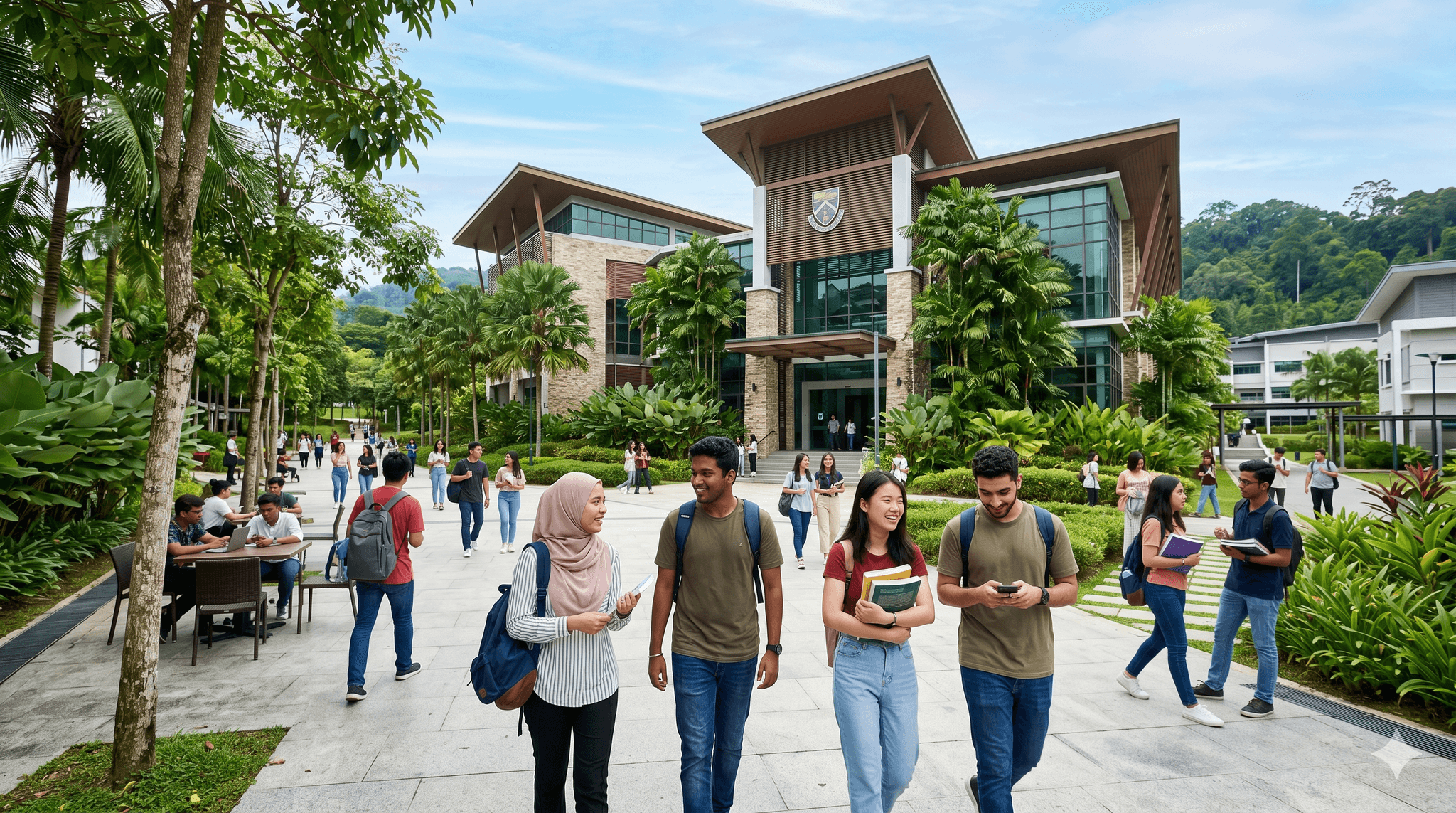
Malaysian universities are divided into Public (characterized by scientific research and lower fees, but slightly harder admission requirements) and Private (characterized by flexibility, modern facilities, and diverse dual-degree programs).
1. Language of Study (English is the Foundation)
All programs for international students in both public and private universities are taught entirely in English. You do not need to learn the Malay language (Bahama Melayu) to study. The only exception is some Islamic Studies or Arabic Language majors available in Arabic at specific universities like IIUM.
2. Number of Years of Study (By Degree)
Intensive English Course: 3 to 6 months (depending on your entry level).
Foundation Year: 1 year (prepares high schoolers for Bachelor's).
Diploma: 2 to 2.5 years.
Bachelor’s Degree: * Business, IT, and Arts: 3 years.
Engineering and Pharmacy: 4 years.
Medicine and Dentistry: 5 years.
Master’s Degree: 1.5 to 2 years.
PhD: 3 years and up (depending on research).
Engineering and Energy: UTP (Backed by PETRONAS).
Technology and AI: APU (The premier digital university).
Business and Tourism: Taylor's University and Sunway University.
Medical Sciences and Pharmacy: MAHSA University and IMU.
Accredited Economical Option: Lincoln University.
Malaysia offers three flexible systems for postgraduate students:
Coursework: Based on lectures, exams, and a minor research project.
Research: Entirely based on a thesis under academic supervision.
Mixed Mode: Combines academic courses and a research thesis.
Note: $1 USD is approximately 4.2 - 4.5 Malaysian Ringgit (RM).
Estimated Annual Tuition Fees (in USD):
Annual Tuition by University Type (Excluding Medicine):
Public Universities: $1,750 - $7,500
Private Universities: $3,200 - $17,000
A student typically spends between $365 and $557 USD per month:
Monthly Budget Details:
Housing: * Independent Apartment: ~$320
Shared Room: ~$128 (Most economical)
Food and Drink:
Eating Out: ~$118
Cooking at Home: ~$75
Groceries: ~$43
Utilities (Elec, Water, Internet): ~$32
Transportation: ~$22
Entertainment: ~$22
Higher education is not free for international students, but you can reduce costs via:
Scholarships: Partial scholarships (30% - 50%) based on academic excellence.
Exchange Programs: If your home university has a partnership.
Part-Time Work: Students are allowed to work up to 20 hours per week during holidays in specific sectors (Restaurants, Hotels, Petrol stations).
Academic Qualifications: For Bachelor’s, a high school diploma (min. 60-65% for most majors). For Master’s, a Bachelor’s degree is required.
English Proficiency: Universities usually ask for IELTS (5.0 - 6.0) or TOEFL equivalent.
Can I study without IELTS?
Yes! You can get an "Acceptance Letter" without IELTS and study an Intensive English Course on campus before starting your degree.
Unlike many countries with only one intake, Malaysia has flexibility:
Intake 1: January / February.
Intake 2: May / June.
Intake 3 (Main): September / October.
Tip: Start your application 2-3 months before the intake to secure your visa.
Health Insurance: Included in the visa fee; covers private and public hospitals.
Banking: You can open a local account (Maybank, CIMB) once you have your student pass. Malaysia is largely a cashless society.
Transport: Students get a 50% discount on LRT, MRT, and RapidKL buses.
Campus Cities: Kuala Lumpur is bustling, while Cyberjaya is a quiet "student paradise."
Housing: Flexible options; on-campus for convenience or off-campus (condos with pools/gyms) starting from $150/month.
Halal Lifestyle: Every restaurant is Halal, and mosques are abundant.
Global Community: You will be among 130,000 international students from 162 countries.
Work in Malaysia: High demand for IT and Engineering graduates.
Return to the Arab World: Excellent reputation in the Gulf market.
Global Gateway: A perfect bridge to pursue further studies or work in Europe/USA.
Distance: 7-10 hours flight from the Middle East. (Mitigated by direct flights and a large local Arab community).
Attendance Rules: Mandatory 80% attendance for visa validity. (This ensures academic seriousness).
Public University Seats: Limited seats for international students. (Private universities often offer better facilities and faster admission).
Language Barrier Outside Campus: Locals speak "Manglish" or Malay. (Apps like Grab and the friendliness of the people make this easy to manage).
We are based in Cyberjaya, Malaysia. Our team has lived the experience you are about to start. Our mission isn't just securing an admission; it’s being your second family here.
Don't leave your future to chance. Contact us for a free, no-obligation consultation today!